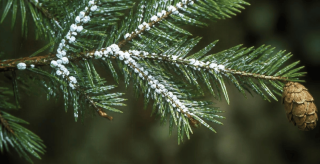
If you see white cottony spots on the branches of your hemlock tree, take a closer look.
It may not be mold, fungus, or snow.
It could be hemlock woolly adelgid.
This tiny insect can cause serious damage to Eastern hemlock trees. The insect itself is difficult to see, but the white woolly material it produces is much easier to spot.
At Strobert Tree Services, this is one of those tree problems where I would rather have a homeowner call early than wait for the tree to start turning brown.
A healthy hemlock can often be protected.
A severely declining hemlock is much harder to bring back.
And right now, during the fall, is an important time to inspect your trees.
What Is Hemlock Woolly Adelgid?
Hemlock woolly adelgid, or Adelges tsugae, is a tiny invasive insect that feeds on hemlock trees.
It is especially damaging to Eastern hemlock.
The insect settles near the base of the needles along small twigs. It uses piercing mouthparts to feed on the tree.
Individual adelgids are tiny. Mature insects are only around 2 millimeters long.
Most homeowners will never notice the actual insect.
What you notice is the wool.
Females produce a white, waxy covering that protects them and their eggs. When many adelgids are present, the underside of the branches can look like it has been covered with tiny pieces of cotton.
Penn State Extension describes these white woolly masses as the most obvious sign of an infestation.
That makes identification easier if you know where to look.
What Is the White Stuff on My Hemlock Tree?
If you see white fluffy material on hemlock branches, look closely at where the needles connect to the twig.
Hemlock woolly adelgid usually gathers at the base of those needles.
The white material may appear as small cotton balls lined up along the underside of the branch.
One thing I would point out to homeowners is that the white material itself can remain after an insect has died.
So seeing white wool does not always tell us how active the infestation is right now.
That is one reason we inspect the whole tree rather than making a treatment decision based on one branch.
We want to see whether the infestation is active, how widespread it is, and how healthy the hemlock remains.
What Does Hemlock Woolly Adelgid Damage Look Like?
The white wool gets your attention.
The condition of the tree tells us how serious the problem has become.
Early hemlock woolly adelgid damage can be easy to miss. Growth may simply become weaker.
As feeding continues, you may notice fewer new shoots, thinning foliage, premature needle loss, gray-green needles, or branches beginning to die.
Severe infestations can eventually kill the tree.
Penn State notes that heavy infestations can cause premature needle drop, reduced twig growth, branch dieback, and tree death. Other stresses, including heat and drought, can make the situation worse.
One pattern I pay attention to is decline moving through the canopy.
If we are looking at an otherwise full hemlock with a light infestation, we have a very different situation from a tree that has already lost much of its foliage.
That distinction matters when deciding whether treatment is worthwhile.
Can a Hemlock Survive Woolly Adelgid?
Yes.
A hemlock with woolly adelgid is not automatically a lost tree.
In fact, treating the tree while it is still healthy is usually the best opportunity to preserve it.
This is why I do not recommend waiting until the tree is obviously dying.
A hemlock needs enough healthy tissue and root function to respond to treatment and recover.
Once severe defoliation has occurred, the outlook changes.
Penn State specifically warns that severely defoliated trees may not recover even after the adelgid is controlled.
That is an important part of an honest tree-health assessment.
Sometimes treatment makes sense.
Sometimes a tree has declined too far.
Our job is to tell the homeowner which situation they have.
Why Fall Is Important for Hemlock Woolly Adelgid
Timing matters with this insect.
Hemlock woolly adelgid has an unusual life cycle.
The insects become active again as temperatures cool. By late September, the developing insects are maturing and beginning the overwintering portion of their life cycle.
That makes late September through October an important treatment period in Pennsylvania.
Penn State identifies this window as one of the best times to manage hemlock woolly adelgid because treatments can target the overwintering females.
This is exactly why I like homeowners to inspect hemlocks in the fall.
Do not wait for spring just because insects are normally associated with warm weather.
Hemlock woolly adelgid does not follow the pattern many people expect.
How Do You Treat Hemlock Woolly Adelgid?
There are several possible approaches to hemlock woolly adelgid treatment.
The right one depends on the size of the tree, its health, the severity of the infestation, nearby water, soil conditions, and where the tree is growing.
Horticultural oils and insecticidal soaps can be useful because they directly contact and kill exposed adelgids.
But coverage is critical.
That is relatively manageable on a small hemlock.
It becomes much harder on a mature tree that may be 30, 40, or 60 feet tall.
Systemic insecticides are another option for some trees. These products can be applied through methods such as soil treatments or other professional applications so the active ingredient moves through the tree.
Penn State lists imidacloprid and dinotefuran among the systemic options used for HWA management. Treatment choice and application method depend heavily on tree condition and site conditions.
This is why there is no one answer to how to get rid of hemlock woolly adelgid.
We first need to understand the tree.
Then we choose the treatment.
Do Not Automatically Fertilize a Declining Hemlock
This is one of the more important things I can tell a homeowner.
If your hemlock looks weak, your first instinct may be to fertilize it.
With hemlock woolly adelgid, that can be the wrong move.
Research summarized by Penn State and University of Maryland Extension indicates that excess nitrogen can help adelgid populations survive and reproduce. Both recommend against fertilizing infested hemlocks.
That surprises people.
We normally associate fertilizer with helping a weak tree.
But tree healthcare is not about automatically adding fertilizer whenever something looks stressed.
We first need to understand why the tree is stressed.
In this case, feeding the tree can also benefit the pest.
Hemlock Woolly Adelgid or Elongate Hemlock Scale?
There is another pest that can create confusion.
Elongate hemlock scale can also leave white material on hemlock foliage.
The difference matters because the insects behave differently and may require different treatment approaches.
Hemlock woolly adelgid typically creates fluffy white masses around the bases of needles along the twigs.
Elongate hemlock scale is usually found directly on the underside of the needles. The coverings tend to look flatter and more elongated rather than like small cotton balls.
A tree can also have both pests at the same time.
Penn State notes that elongate hemlock scale and hemlock woolly adelgid can occur together, which can increase stress on an already weakened tree.
That is another reason I would not recommend treating a hemlock based only on a quick internet photo comparison.
Correct identification comes first.
How Can You Help a Hemlock With Woolly Adelgid?
Good tree care still matters.
Hemlocks already dealing with drought, compacted soil, root damage, or excessive heat have less ability to handle another source of stress.
During dry periods, appropriate watering can help.
Protect the root zone from unnecessary compaction.
Use mulch properly, but do not pile it against the trunk.
Avoid damaging roots during construction or landscaping.
And monitor the tree.
If you have several hemlocks and one develops woolly adelgid, check the others too.
I would pay particular attention to the undersides of smaller twigs and branches. That is where the white woolly masses are easiest to find.
Should Every Hemlock Be Treated?
No.
This is another place where professional judgment matters.
Penn State does not recommend automatically treating hemlocks that have no evidence of HWA unless nearby infestation creates a clear risk.
We do not want to apply insecticides simply because a pest exists somewhere in the region.
Instead, I prefer to inspect the tree, determine whether the insect is present, evaluate the tree's value and health, and then decide whether treatment makes sense.
That is better tree care.
It also avoids unnecessary treatments.
When Should You Call an Arborist?
If you see white cottony spots on your hemlock, do not wait for the entire tree to turn brown.
Look underneath the branches.
Check several areas of the tree.
Then have the problem identified by a professional who can detect tree diseases and pests before they take hold.
At Strobert Tree Services, we look at more than whether white material is present.
We evaluate how much of the tree is affected, how healthy the canopy remains, whether other pests are present, and which treatment option makes sense for that specific tree.
The goal is not simply to kill an insect.
The goal is to protect a tree that can still be protected.
If you are seeing hemlock woolly adelgid, white fluffy material on your hemlock branches, thinning needles, or unexplained dieback, call Strobert Tree Services for professional tree plant health care in Delaware and Pennsylvania. Call us at 1-800-TREE-SERVICE or request a free consultation online.
The sooner we identify the problem, the more options we usually have.