If you notice a sunken, cracked, or dead-looking area on the bark of your tree, do not automatically assume it is just an old injury.
It could be a tree canker.
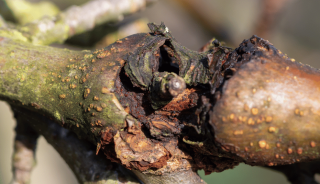
Cankers can show up as dark patches, cracked bark, sunken areas, swelling around a wound, or sections of bark that appear dead.
Sometimes sap or other fluid comes from the area.
Other times, the first thing a homeowner notices is a branch above the damaged area starting to die.
At Strobert Tree Services, when I see a canker, I do not just look at the spot itself.
I want to know where it is.
I want to know how large it is.
I want to know whether it is expanding.
And most importantly, I want to know what caused it.
A small canker on a branch can often be managed very differently from a large canker on the main trunk.
What Is a Tree Canker?
A tree canker is a localized area of dead or damaged bark and the living tissue underneath it.
It is important to understand that "canker" is not the name of one disease.
Many different fungi and some bacteria can cause cankers.
Trees can also develop canker-like damage after physical injuries or environmental stress.
Common fungal causes include Botryosphaeria, Cytospora, Nectria, and other pathogens.
University of Maryland Extension describes young cankers as areas that may look slightly darker and more sunken than the healthy bark around them. As they expand, they can kill more of the living tissue in a branch or trunk.
That is when a small bark problem can become a much bigger tree-health problem.
What Does a Canker Look Like on a Tree?
There is no single appearance.
That is one reason homeowners can have trouble identifying them.
A canker on a tree may look like a shallow depression in otherwise smooth bark.
It may look like a crack that keeps getting larger.
Some develop raised ridges of callus tissue around their edges.
Others develop rough, distorted bark.
You might also see small red, orange, brown, or black fungal structures around the damaged area.
Penn State recommends looking for localized rough or cracked bark, layers of callus tissue, and small fungal structures around the damaged area when inspecting for hardwood cankers.
One clue I pay particular attention to is what is happening beyond the canker.
If a branch is healthy below the damaged area but dead above it, the canker may be interfering with the movement of water and nutrients.
Why Is a Branch Dying Above a Canker?
This is where cankers become more serious.
The living layer beneath a tree's bark helps move sugars and supports new growth.
If a canker continues expanding around a branch, it can eventually girdle that branch.
Once that happens, everything beyond the damaged section may die.
A small twig can be girdled fairly quickly.
A large branch may take longer.
The same basic problem can happen on a young tree's trunk.
If enough of the trunk circumference is damaged, the entire tree can be affected.
That is why location matters so much.
A canker that we can remove by pruning one branch is one problem.
A canker wrapped around part of the main trunk is another.
Why Do Trees Get Cankers?
One of the most useful things I can tell homeowners is this:
Cankers often take advantage of trees that are already stressed or injured.
The pathogen may not be the first problem.
It may be the second problem.
We commonly look for drought stress, root damage, recent transplanting, mower injuries, improper pruning, storm damage, frost injury, construction around the root zone, or other problems that weakened the tree first.
For example, Nectria can enter wood that was damaged by freezing, hail, insects, animals, or other injuries. Penn State notes that trees weakened by transplanting, root disturbance, or freezing are especially susceptible.
That changes how I look at treatment.
If we only remove a diseased branch but ignore the reason the tree became vulnerable, we may not have solved the whole problem.
Is a Tree Canker the Same as a Wound?
No.
But the two can look similar.
A mower strike, rubbing branch, pruning injury, deer damage, or construction damage can leave exposed or sunken bark.
A canker may start around one of those injuries.
But not every wound becomes infected.
This is where experience matters.
We look at the shape of the damage.
We look for callus growth.
We look for discoloration.
We look for fungal structures.
We look at whether the damaged area is continuing to expand.
And we look at the tree around it.
A wound that is successfully closing is very different from a canker that is killing more tissue each year.
Can a Tree Recover From a Canker?
Sometimes.
A healthy tree can often compartmentalize a small infection.
In simple terms, the tree builds new tissue around the damaged area and limits how far the problem spreads.
Penn State notes that vigorous trees can sometimes form callus tissue, wall off certain canker infections, and recover. Stressed trees are less successful at doing that.
This is why I never answer "Can you save it?" based only on the word canker.
I need to see the tree.
A small canker on a removable branch may have a good outlook.
A large perennial canker on the trunk can shorten the life of the tree and may weaken the wood.
On some maples, for example, Eutypella canker can create a large swollen area on the trunk. Penn State warns that these areas may become more vulnerable to decay and wind breakage.
So we are not only thinking about tree health.
We may also be thinking about structural safety.
What Is the Best Tree Canker Treatment?
There is no spray that simply makes an established canker disappear.
That is important.
For many common canker diseases, removing infected branches and reducing stress on the tree are the main management tools.
University of Maryland states that established cankers generally do not have a chemical cure and recommends pruning affected branches back into healthy wood when possible.
But pruning has to make sense for that specific tree.
Do not cut directly at the visible edge of the canker.
The infection may extend farther into the wood than you can see.
Penn State recommends pruning several inches below visible cankers on infected hardwood branches. It also recommends doing the work during dry conditions rather than wet weather, when disease spread can be greater.
This is one of those situations where aggressive DIY pruning can create a second problem.
You want to remove diseased tissue without making unnecessary large wounds or ruining the structure of the tree.
Should You Cut a Canker Out of the Trunk?
Usually, homeowners should not start cutting bark and wood out of the main trunk themselves.
There are some specific situations where trained professionals may remove diseased tissue from a high-value tree.
But it is not something I would recommend doing just because an area looks damaged.
Cutting into healthy cambium can make the injury larger.
And if the canker is already extensive, carving at the trunk may not solve the problem.
A trunk canker deserves an assessment first.
We need to know what type of damage we are dealing with and whether the tree remains structurally sound.
What Trees Get Cankers?
Almost any woody tree or shrub can develop some type of canker.
In our region, we see canker diseases associated with trees such as maple, oak, beech, redbud, spruce, dogwood, cherry, peach, plum, and many other landscape plants.
Different pathogens prefer different hosts.
That is why the species of tree matters when we diagnose the problem.
A sunken area on a blue spruce may lead me in a different direction than a swollen canker on a maple or an oozing wound on a cherry tree.
The word canker tells us what kind of damage we are looking at.
It does not automatically tell us what caused it.
Can You Prevent Tree Cankers?
You cannot prevent every infection.
But reducing unnecessary tree stress goes a long way.
Avoid damaging trunks with mowers and string trimmers. Protect roots during construction. Water appropriately during extended dry periods. Do not pile mulch against the trunk. Make proper pruning cuts. Avoid unnecessary injuries to bark.
I also like to inspect trees after storms or construction work.
A wound today can become an entry point for a pathogen later.
And if you already know a tree has a canker, keep an eye on it.
Is the area getting larger?
Is callus tissue forming?
Are branches above it beginning to die?
Has the canopy started thinning?
Those changes tell us more than one photograph taken on one day.
Why Fall and Winter Are Good Times to Look at Tree Bark
Once leaves come down, we can see things that were hidden all summer.
The trunk is easier to inspect.
Branch structure is easier to follow.
Dead sections become easier to identify.
That makes fall and winter a useful time to notice cankers, cracks, old wounds, and other bark problems.
That does not mean every affected tree should automatically be pruned in fall.
Pruning timing depends on the tree and disease involved, and wet autumn pruning can increase infection risk with some canker pathogens.
The important thing is to identify the problem first.
Then we decide what should be done and when.
When Should You Call an Arborist?
A small bark scar on an otherwise healthy tree may only need monitoring.
I would want a closer look if you see a sunken or expanding area on the trunk, bark cracking around a wound, oozing or unusual discoloration, branch dieback above the damaged area, repeated callus growth around the same spot, or a canker on a major limb or the main trunk.
At Strobert Tree Services, we look beyond the visible wound.
We look at the entire tree.
We want to understand what caused the canker, whether the tree is successfully containing it, whether pruning can remove it, and whether the damaged area is creating a structural concern.
Sometimes the right answer is pruning.
Sometimes it is improving tree health and monitoring the area.
Sometimes a main-trunk canker has progressed far enough that we need to talk about the long-term safety of the tree.
The important part is getting the diagnosis right before deciding what comes next.
If you notice a tree canker, sunken bark, cracking, oozing, or unexplained branch dieback, call Strobert Tree Services for professional tree plant health care in Delaware and Pennsylvania. Call us at 1-800-TREE-SERVICE or request a free consultation online.