You pick up a leaf, turn it over, and wonder what tree it came from. It sounds simple, but with thousands of tree species out there, staring at a leaf and hoping to recognize it rarely works. The trick that arborists use is not memorizing every leaf. It is asking a short series of yes-or-no questions that narrow the field fast. Answer four or five simple questions about a leaf and you can usually get to the species, or at least the family. Here is exactly how to do it, using the same approach I use in the field.
How do you identify a tree by its leaves?
To identify a tree by its leaves, work through five questions in order: Is the leaf simple or compound? Are the leaves arranged alternate or opposite on the stem? Is the leaf lobed or unlobed? Is the margin smooth, toothed, or serrated? And how are the veins arranged? Each answer narrows the possibilities until you reach the species.
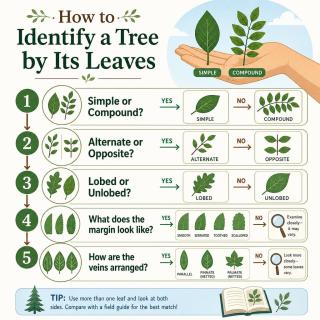
Step 1: Simple or compound?
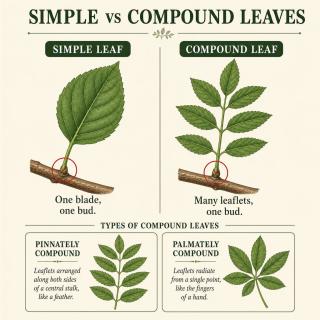
This is the first and most important split, and it trips up more people than any other. A simple leaf is a single blade attached to the stem by its stalk. A compound leaf is made of several smaller leaflets all attached to one central stalk.
The test that never fails: find the bud. A leaf, whether simple or compound, always has a bud where its stalk meets the woody stem. Leaflets do not have buds at their base. So if you trace the stalk back and find several leaflets connecting to one stem that has a single bud where it meets the branch, you are holding one compound leaf, not several simple ones.
- Simple leaves: maple, oak, birch, dogwood, sycamore, elm, sweetgum
- Compound leaves: ash, hickory, walnut, black locust, boxelder
Compound leaves come in two main patterns. Pinnately compound leaves have leaflets arranged in pairs along a central stalk, like a feather. Palmately compound leaves have leaflets radiating from a single point, like fingers from a palm.
Step 2: Alternate or opposite?
Next, look at how the leaves attach to the branch. This is one of the most powerful narrowing questions because relatively few common trees have opposite leaves.
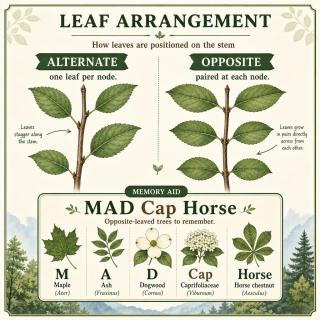
- Opposite: leaves grow in pairs, directly across from each other at each node
- Alternate: leaves grow one at a time, staggered along the branch
There is a classic arborist memory trick for the opposite-leaved trees: MAD Cap Horse. It stands for Maple, Ash, Dogwood, and the Caprifoliaceae family (viburnums and a few others), plus Horse chestnut. If a tree has opposite leaves, it is very likely one of these. Almost everything else, oak, birch, elm, sycamore, hickory, willow, is alternate.
You need the branch for this step, which is why leaf arrangement is easier to check on a living tree than from a single fallen leaf. If you only have one leaf, you can still get far using the other four questions.
Step 3: Lobed or unlobed?
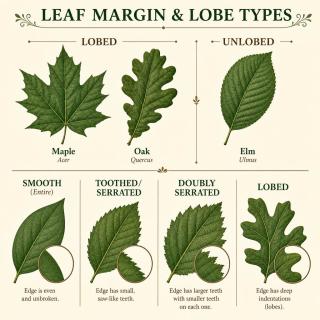
Now look at the outline of the leaf. Lobes are the rounded or pointed projections that stick out from the main body of the leaf, separated by indentations called sinuses.
- Lobed: the leaf edge has distinct projections. Oaks and maples are the classic lobed trees in our region.
- Unlobed: the leaf has a continuous outline without deep projections, like elm, birch, and dogwood.
Among lobed leaves, the shape of the lobes tells you a lot. Rounded lobes point toward the white oak group. Pointed, bristle-tipped lobes point toward the red oak group. Our post on oak tree identification breaks down how to tell the oak groups apart, since oaks are one of the most common and most confusing trees to identify in Delaware and Pennsylvania.
Step 4: What does the margin look like?
The margin is the edge of the leaf, and it is one of the most reliable identifying features. Look closely at the outline:
- Smooth (entire): a clean, unbroken edge, like dogwood and magnolia
- Toothed (serrated): small tooth-like points along the edge, like birch, elm, and cherry
- Doubly serrated: larger teeth with smaller teeth on them, common in birch and elm
- Lobed: the deep indentations covered in Step 3
The margin often separates trees that otherwise look similar. Elm leaves, for example, are known for their distinctive doubly serrated edges and an asymmetrical base where the two sides of the leaf meet the stalk unevenly. Our post on how to identify an elm tree covers that telltale feature in detail.
Step 5: How are the veins arranged?
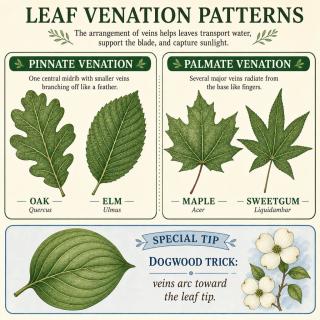
Venation is the final refinement, and sometimes it is the detail that clinches an identification. There are two main patterns:
- Pinnate: one central vein (the midrib) runs down the leaf with smaller veins branching off it, like a feather. Oak, elm, and beech are pinnately veined.
- Palmate: several major veins radiate out from the base of the leaf, like fingers spreading from a palm. Maple and sweetgum are palmately veined.
One venation trick is especially useful in our region. Dogwood veins curve and arc toward the leaf tip rather than running straight to the margin. That arcing vein pattern is nearly unique among common Eastern trees, so if you see it, you are almost certainly looking at a dogwood. Our post on dogwood identification covers the species in more detail.
Putting it together: a quick example
Say you find a leaf and work through the questions. It is a single blade (simple). The leaves grow in pairs on the branch (opposite). It has five pointed lobes. The margin between the lobes is fairly smooth. The veins radiate from the base (palmate). Simple, opposite, lobed, palmately veined points straight to a maple.
Now another leaf. Single blade (simple). Staggered on the branch (alternate). Deep, rounded lobes. Smooth margins. Pinnate veins. Simple, alternate, lobed with rounded lobes, pinnately veined is the signature of a white oak.
The same five questions get you there every time. With practice, you run through them in seconds.
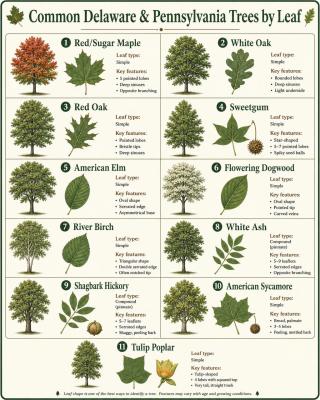
Common Delaware and Pennsylvania trees by leaf
| Tree | Leaf type | Key features |
|---|---|---|
| Red / sugar maple | Simple, opposite | Palmate veins, pointed lobes, palmate shape |
| White oak | Simple, alternate | Rounded lobes, pinnate veins |
| Red oak | Simple, alternate | Pointed, bristle-tipped lobes |
| Sweetgum | Simple, alternate | Star-shaped, 5 to 7 pointed lobes, palmate veins |
| American elm | Simple, alternate | Doubly serrated margin, asymmetrical base |
| Flowering dogwood | Simple, opposite | Smooth margin, arcing curved veins |
| River birch | Simple, alternate | Doubly toothed, diamond shape, peeling bark |
| White ash | Compound, opposite | 5 to 9 leaflets, opposite branching |
| Shagbark hickory | Compound, alternate | 5 leaflets, shaggy peeling bark |
| American sycamore | Simple, alternate | Large, maple-like lobes, mottled bark |
| Tulip poplar | Simple, alternate | Distinctive four-lobed, flat-topped shape |
Watch out for these identification traps
A few things reliably fool people, so keep them in mind:
- Sycamore versus maple. Both have large lobed leaves, but sycamores have alternate leaves and mottled, peeling bark, while maples have opposite leaves. Our post on sycamore leaf versus maple covers the distinction.
- Leaflets mistaken for leaves. A single ash or hickory leaflet looks like a whole small leaf. Always trace back to the bud before deciding.
- Juvenile leaves. Young trees and the sprouts at the base of a trunk (epicormic shoots) can produce leaves that look different from the mature canopy. Mulberry is a notorious example, with deeply lobed juvenile leaves and unlobed adult ones.
- Fall color changes. A leaf's shape stays constant, but color shifts through the season, so do not rely on color alone. Our post on why leaves change color in fall explains the pigments behind it.
Frequently asked questions
Can you identify a tree from just one leaf?
In most cases, yes. A single leaf provides shape, margin, size, and venation, which together are often enough for an accurate identification. Having the branch helps because it lets you check leaf arrangement (opposite versus alternate), but a well-preserved leaf carries most of the information you need. When one leaf is not enough, bark, buds, fruit, and overall tree shape fill in the rest.
What is the difference between a simple and compound leaf?
A simple leaf is a single blade attached to the stem by one stalk. A compound leaf is made of several leaflets all attached to a single central stalk. The reliable test is to find the bud: a true leaf has a bud where its stalk meets the woody branch, while individual leaflets do not. Trace the stalk back to the bud, and count everything past it as one leaf.
Which trees have opposite leaves?
Relatively few common trees have opposite leaves, which makes this a powerful identification clue. The memory aid is MAD Cap Horse: Maple, Ash, Dogwood, the Caprifoliaceae family (viburnums and relatives), and Horse chestnut. Nearly all other common trees, including oak, birch, elm, sycamore, hickory, and willow, have alternate leaves arranged one per node along the branch.
How do I tell a maple leaf from a sycamore leaf?
Both have large, lobed, palmate leaves, but two features separate them. Maples have opposite leaf arrangement, with leaves in pairs, while sycamores have alternate arrangement, one leaf per node. Sycamores also have distinctive mottled, patchy bark that peels to reveal cream and green tones underneath, and they produce round seed balls. Maples produce the familiar winged samaras, or helicopter seeds.
What leaf shape does an oak tree have?
Oaks have simple, alternate, lobed leaves with pinnate venation. The lobe shape identifies the group: rounded lobes indicate the white oak group, while pointed, bristle-tipped lobes indicate the red oak group. Oak leaves vary considerably between species and even on the same tree, so use the rounded-versus-pointed distinction as your starting point, then confirm with acorn shape and bark.
Is a leaf enough, or do I need bark and buds too?
A leaf alone identifies most common trees, but bark, buds, fruit, and growth form are valuable confirmation, especially for tricky species or in winter when leaves are gone. If a leaf identification feels uncertain, checking a second feature usually resolves it. For a definitive answer on a valuable or questionable tree, especially if you suspect disease, a certified arborist can identify the species in person and assess the tree's health at the same time.
When identification is the first step to good care
Knowing what tree you have is genuinely useful, not just satisfying. Different species need different pruning timing, have different disease vulnerabilities, and respond differently to care. Correctly identifying an oak, for instance, tells you to avoid pruning during oak wilt season. Recognizing an ash means watching for emerald ash borer. Identification is where good tree care starts.
If you have a tree you cannot identify, or you have identified it and want to know whether it is healthy, our ISA-Certified Arborists at Strobert Tree Services can help. We identify species, assess condition, and recommend the right care across Delaware, Pennsylvania, and New Jersey. For more on the fundamentals, our guides on how to identify trees and the parts of a tree are good companions to this one. Call us at 1-800-TREE-SERVICE or request a free consultation online.