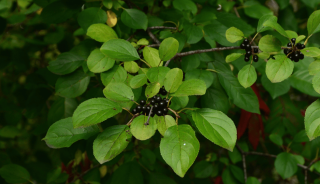
Buckthorn is an invasive shrub or small tree that forms dense thickets and crowds out native plants. The two common types in our region are common buckthorn (Rhamnus cathartica) and glossy buckthorn (Frangula alnus). You can identify it by its oval leaves with curved veins, dark berries, and bright orange inner bark. Cutting it alone does not kill it, so removal usually requires treating the stump.
That is the short version. If you have a shrubby, hard-to-kill plant taking over a fence line, a wood edge, or the back of your property in Delaware or Pennsylvania, there is a good chance it is buckthorn. Here is how to know for sure and what actually works to get rid of it.
What Is Buckthorn?
Buckthorn is a non-native, invasive woody plant that was brought to North America from Europe and Asia in the 1800s as an ornamental hedge. It escaped cultivation and now spreads aggressively through woods, yards, and fence lines across the Northeast and Mid-Atlantic.
There are two types we deal with most often:
- Common buckthorn (Rhamnus cathartica) grows in a wide range of soils, including dry sites, and often has small thorns at the tips of its twigs.
- Glossy buckthorn (Frangula alnus) prefers wetter ground, has glossy leaves without teeth, and lacks thorns.
Both can grow as a large multi-stemmed shrub or a small tree, sometimes reaching 20 to 25 feet. Both are treated as invasive, and both are a problem for the same reasons.
How Do I Identify Buckthorn?
The fastest way to identify common buckthorn is to look for oval leaves with three to five pairs of veins that curve toward the leaf tip, small thorns at the branch ends, and bright orange inner bark when you scratch the surface. It also holds green leaves later into fall than almost anything around it.
Here is what to look for, feature by feature:
- Leaves: oval to egg-shaped, finely toothed edges, dark glossy green, with distinctive veins that curve and run roughly parallel toward the tip of the leaf.
- Leaf arrangement: often sub-opposite, meaning the leaves are nearly across from each other but slightly staggered.
- Thorns: common buckthorn usually has a short, sharp thorn or spine at the tip of many twigs. Our guide to identifying bushes with thorns can help you compare it with lookalikes.
- Inner bark: scratch the outer bark with a knife or your fingernail. Buckthorn reveals a bright orange to yellow layer underneath. This is one of the most reliable identification clues.
- Berries: clusters of small, dark purple to black berries appear on female plants in late summer and fall. They are mildly toxic to people and act as a laxative, which is where the name "cathartica" comes from.
- Late leaf drop: buckthorn keeps its green leaves well into late fall, after most native trees and shrubs have already dropped theirs.
That last point is the reason fall is the easiest time of year to spot it. When everything around it is bare and brown, buckthorn stands out as a patch of stubborn green.
Is Buckthorn Invasive?
Yes. Buckthorn is one of the most problematic invasive plants in the Northeast and Mid-Atlantic. Pennsylvania and many other states classify common buckthorn as an invasive species, and planting or selling it is discouraged or restricted. It spreads faster than native plants can compete with, which is what makes it so damaging.
It behaves much like other aggressive invaders we manage, including Tree of Heaven and Callery (Bradford) pear. If you are dealing with more than one problem plant, our posts on spotted lanternfly, whose preferred host is the invasive Tree of Heaven, and on Bradford pear are worth a look.
Why Is Buckthorn a Problem?
Buckthorn causes damage because it grows faster, leafs out earlier, and holds its leaves later than the native plants around it. That extended season lets it shade out everything beneath it and take over an area completely.
The specific problems it creates:
- Dense thickets: buckthorn forms thick stands that block sunlight and prevent native wildflowers, shrubs, and tree seedlings from growing.
- Rapid spread: birds eat the berries and carry the seeds far and wide. Because the berries have a laxative effect, the seeds are spread quickly and over a large area.
- Poor wildlife value: despite producing berries, buckthorn does not provide the nutrition that native plants give birds and other wildlife.
- Long-lived seed bank: seeds can remain viable in the soil for years, so one mature plant can keep producing new seedlings long after it is gone.
- Pest links: common buckthorn serves as an alternate host for the soybean aphid and for oat crown rust, which ties it to agricultural pest problems too.
Left alone, a few buckthorn plants along a property line can become a wall of buckthorn across the back of a yard within a few years.
How Do I Get Rid of Buckthorn?
The method depends on the size of the plant. Small seedlings can be pulled or dug out by hand when the soil is moist. Larger plants need the stump treated after cutting, because buckthorn resprouts aggressively if you simply cut it down. Cutting alone almost always makes the problem worse, not better.
Here are the main approaches:
- Hand-pulling small plants: seedlings and young plants can be pulled or dug when the ground is soft, as long as you get the roots. Our guide on tree root removal covers how to do this without leaving root pieces behind.
- Cut-stump treatment: for larger buckthorn, the standard approach is to cut the stem close to the ground and immediately apply a systemic herbicide to the fresh cut surface. This carries the product down into the roots and prevents resprouting.
- Basal bark treatment: on smaller-diameter stems, an herbicide can be applied to the lower bark without cutting at all.
- Foliar treatment: for low, dense patches of seedlings, a carefully applied foliar herbicide can treat many small plants at once.
Whatever the method, grinding out or removing the cut stumps and dealing with the leftover root crowns matters. If you want the stump gone entirely, our post on how to get rid of a tree stump explains the options.
Does Cutting Buckthorn Kill It?
No. Cutting buckthorn without treating the stump does not kill it. In fact, it usually makes the stand thicker. A cut buckthorn stump sends up multiple vigorous new shoots, so where you had one stem, you can end up with five or six. This is the single most common mistake homeowners make with buckthorn.
To actually kill the plant, the cut has to be paired with a stump treatment, or the plant has to be pulled out by the roots while it is small. That is why a quick weekend of cutting often leaves people more frustrated the following year.
When Is the Best Time to Remove Buckthorn?
Late fall and early winter are the best times to remove buckthorn. Because it holds its green leaves after native plants have gone dormant, it is easy to find and identify in fall. Cut-stump treatments also work well during this period, and treating when surrounding native plants are dormant reduces the risk of harming them.
That said, buckthorn can be worked on in other seasons too. The most important thing is to catch it before the berries spread a new generation of seeds, and to treat the stumps so your work is not undone by resprouting.
What Should I Plant Instead of Buckthorn?
Once buckthorn is removed, replanting the area with native species helps keep it from coming back and restores value for local wildlife. Native shrubs and small trees fill the same space buckthorn occupied, but they support birds and pollinators the way buckthorn never did.
Good native options for our region include serviceberry, winterberry holly, arrowwood viburnum, redbud, and dogwood. Our guides to Delaware's native trees and the best trees for small yards can help you choose a replacement that fits your space.
Frequently Asked Questions
What does buckthorn look like?
Buckthorn is a large shrub or small tree with oval, finely toothed leaves whose veins curve toward the tip. Common buckthorn has small thorns at its twig tips and bright orange inner bark when scratched. It produces clusters of dark purple-black berries in fall and keeps its green leaves later into the season than most native plants around it.
Are buckthorn berries poisonous?
Buckthorn berries are mildly toxic to people and act as a strong laxative if eaten, which is where the species name "cathartica" comes from. They are not considered deadly, but they can cause stomach upset and should be kept away from children. Birds eat them without harm, which is exactly how buckthorn spreads so widely.
Why does buckthorn keep coming back after I cut it?
Buckthorn resprouts aggressively from the cut stump, so cutting alone does not kill it and often produces several new stems where there was one. On top of that, its seeds stay viable in the soil for years, so new seedlings keep appearing. Lasting control requires treating the stump or pulling plants out by the roots, plus monitoring for seedlings.
Is buckthorn hard to get rid of?
Buckthorn is difficult to eradicate because it resprouts after cutting and leaves behind a long-lived seed bank. A single removal rarely finishes the job. Successful control usually combines proper stump treatment or root removal with several years of follow-up to catch new seedlings before they mature and produce berries.
Can buckthorn damage my other trees?
Buckthorn does not attack other trees directly, but it harms them by competition. Its dense thickets shade out tree seedlings and compete for water and nutrients, which prevents the next generation of native trees from establishing. Over time, an area dominated by buckthorn loses its diversity and becomes much harder to restore.
Should I remove buckthorn myself or hire a professional?
Small seedlings are reasonable to pull by hand. Large, established buckthorn or a thick stand is harder, because it requires proper cutting, stump treatment, and follow-up to keep it from returning. For big infestations, or when buckthorn is tangled in with plants you want to keep, a professional can remove it correctly and advise on restoring the area.
Getting Buckthorn Under Control
Buckthorn is beatable, but only with the right approach. Identify it correctly, remove it before the berries spread more seed, treat the stumps so it does not resprout, and plan on a few years of follow-up to clear the seed bank. Done right, you can take back a fence line or wood edge and replant it with natives that actually belong there.
If you have a buckthorn problem you want handled correctly, our team at Strobert Tree Services can identify it, remove it, and recommend the right next step for your property. We offer removal and ongoing plant health care across Delaware, Pennsylvania, and New Jersey. Call us at 1-800-TREE-SERVICE or request a free consultation online.