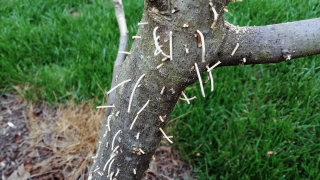
Are there tiny "toothpicks" sticking out of your tree?
Do you see small holes in the trunk with sawdust coming out of them?
That is something we would want to look at.
One of the first things I suspect when I see those symptoms is an ambrosia beetle.
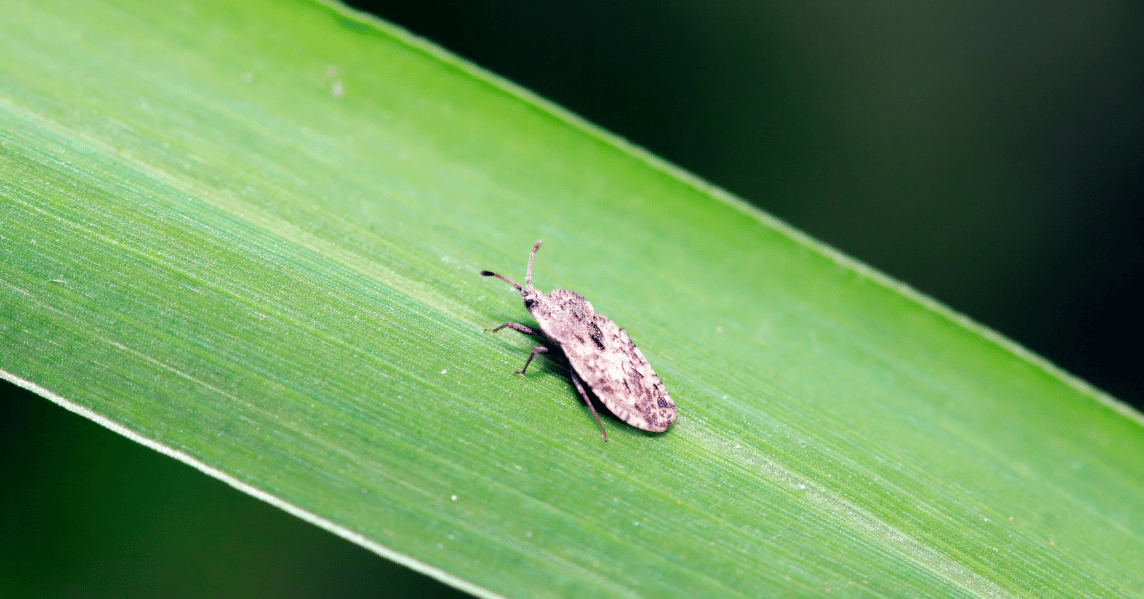
These beetles are tiny. Most homeowners will never actually see one. Instead, you see the evidence they leave behind.
The most recognizable sign is a thin tube of compacted sawdust sticking straight out of the trunk. Arborists often call these frass toothpicks.
If you see them, do not ignore them.
At Strobert Tree Services, we look at more than the holes themselves. Ambrosia beetles are often a sign that something else has already placed the tree under stress.
That makes finding the beetle only part of the diagnosis.
What Is an Ambrosia Beetle?
An ambrosia beetle is a very small wood-boring beetle.
But there is something unusual about the way it feeds.
The beetle does not simply eat its way through the tree. A female tunnels into the wood and introduces a fungus into the gallery she creates. The beetles and their young feed on that fungus.
That relationship is one reason ambrosia beetle treatment can be difficult. Once the beetle has entered the wood, it is protected from many insecticide applications. Systemic insecticides are also limited because the beetle is feeding on its fungal food source rather than consuming the tree itself.
Many ambrosia beetles are attracted to trees that are already stressed, weakened, recently transplanted, injured, or declining.
That is an important point.
When we find ambrosia beetles, I do not just ask, "How do we kill the beetle?"
I also ask, "Why did this tree become attractive to the beetle in the first place?"
What Are the Signs of Ambrosia Beetles?
The classic ambrosia beetle signs are hard to miss once you know what you are looking for.
Look for:
- Toothpick-like tubes sticking from the trunk
- Tiny holes in the bark
- Fine sawdust on the trunk
- Sawdust at the base of the tree
- Wilting leaves
- Delayed leaf growth
- Premature leaf drop
- Branch dieback
- Sudden decline
The "toothpicks" are made from material pushed out while the beetle creates its tunnel. This material is commonly called ambrosia beetle frass.
University of Georgia Extension describes these toothpick-like strings of sawdust as a common sign of an active granulate ambrosia beetle infestation.
One thing homeowners should know is that these tubes are fragile.
Wind and rain can knock them off.
So you may only find the ambrosia beetle holes or loose sawdust afterward. The absence of perfect toothpicks does not automatically mean the tree is clear.
Why Are There Toothpicks Sticking Out of My Tree?
This is one of those tree symptoms that looks almost too strange to be natural.
We sometimes hear homeowners describe them as wooden hairs, spikes, strings, or little sticks.
If you search for "toothpicks sticking out of tree," ambrosia beetles should be high on the list of possibilities.
Each tube can mark a point where a beetle bored into the tree and pushed material back through the entrance.
The holes themselves may look like very small pinholes or pencil-lead holes in the tree trunk.
But I would not diagnose a tree from one symptom alone.
Other insects can produce holes and sawdust. Woodpeckers can also leave patterns of holes. Tree injuries and other borers can create debris that looks similar.
The toothpick frass is a strong clue. It is not a reason to skip a proper inspection.
What Does Ambrosia Beetle Damage Look Like?
Ambrosia beetle damage happens below the surface.
The beetles bore into the wood and create galleries. They also introduce fungi into those galleries.
From the outside, the first warning may only be a few tiny holes.
Then the tree may begin to wilt or decline.
In severe infestations, you can see many entrance holes across part of the trunk. There may also be large amounts of frass or sawdust at the base of the tree.
Young and recently transplanted trees concern me the most.
Research from UGA Extension notes that attacks on nursery trees and newly transplanted trees are often fatal.
That does not mean every tree with an ambrosia beetle hole will die.
It does mean you should take the symptoms seriously.
Can a Tree Survive Ambrosia Beetles?
Yes, in some cases.
But the answer depends heavily on the tree.
When someone asks me, "Can a tree survive ambrosia beetles?", I want to know several things.
How large is the tree?
How many attacks are present?
Is the canopy already wilting?
Was the tree recently planted?
Has the property been unusually wet or dry?
Has the root zone been disturbed?
Is there trunk or root damage?
A mature tree with limited activity may have a very different outlook from a small, newly planted tree covered in frass tubes.
Heavily infested trees may not be salvageable. University of Maryland Extension recommends removal when trees are heavily infested and cannot recover.
This is why early evaluation matters.
Do not wait for half the canopy to die before asking what caused the problem.
Ambrosia Beetles on Japanese Maples, Dogwoods, Redbuds and Other Trees
One frustrating thing about these insects is their broad host range.
We can see ambrosia beetles on Japanese maple, dogwood, redbud, cherry, magnolia, and many other landscape trees.
University of Delaware Cooperative Extension lists hosts that include cherry, dogwood, magnolia, maple, oak, redbud, tulip poplar, and many other species.
That means homeowners should not assume a favorite ornamental tree is safe simply because it is not an oak or another large forest tree.
We are especially watchful when a tree has recently been transplanted or is dealing with root, soil, moisture, or construction stress.
Granulate Ambrosia Beetle vs. Redbay Ambrosia Beetle
Not every ambrosia beetle is the same.
The granulate ambrosia beetle is one species commonly associated with ornamental and landscape trees. It has a very wide host range.
The redbay ambrosia beetle is a different and particularly serious pest because it can spread the fungus responsible for laurel wilt disease.
Laurel wilt primarily threatens trees in the laurel family. It should not be confused with every ordinary ambrosia beetle infestation found on a maple, dogwood, or redbud.
Correct identification matters because the risk and management plan can be different.
Ambrosia Beetle vs. Bark Beetle
People also use the names bark beetle and ambrosia beetle interchangeably.
There is some overlap in how these insects are classified, but their feeding strategies are different.
True bark-feeding beetles generally feed in tissues beneath the bark.
Ambrosia beetles tunnel into woody tissue and cultivate fungi inside their galleries. That fungus becomes their main food source.
For a homeowner, the exact insect classification is less important than getting the cause of the tree's decline right.
The wrong diagnosis can lead to the wrong treatment.
What Is the Best Ambrosia Beetle Treatment?
This is where I want homeowners to have realistic expectations.
There is no simple spray that reliably fixes an established infestation.
Once the beetles are deep inside the tree, ambrosia beetle control becomes much harder.
Preventive trunk treatments can sometimes help protect susceptible trees during periods of beetle activity. Timing is critical. Once beetles have entered the wood, treatment options become much more limited.
That is why I would be cautious with anyone promising they can simply "spray the beetles out."
Our first job is to determine how badly the tree has been affected.
Then we look for the stress that may have contributed to the attack.
How to Prevent Ambrosia Beetles
The best ambrosia beetle prevention often starts with keeping the tree healthy.
That sounds simple. But we see preventable tree stress all the time.
Avoid:
- Excessive mulch against the trunk
- Drought stress
- Constantly saturated soil
- Root damage
- Soil compaction
- Mower and string-trimmer injuries
- Unnecessary heavy pruning
- Poor planting practices
New trees need special attention.
A tree can look healthy above ground while its root system is struggling below ground.
That is one of the reasons I do not automatically blame the beetle for everything I see.
Sometimes the beetle is the problem.
Sometimes it is also evidence of a larger problem.
Should You Call an Arborist?
If you see frass toothpicks, tiny trunk holes, unexplained sawdust, wilting, or sudden tree decline, I recommend having the tree evaluated.
Take photos if you can.
Look at the entire tree.
And do not remove all the evidence before someone can inspect it.
At Strobert Tree Services, we can look at the ambrosia beetle signs, the condition of the canopy, the trunk, the root zone, and the overall health of the tree.
The goal is not simply to tell you there is a beetle.
The goal is to determine what is happening, whether the tree can reasonably be saved, and what you should do next.
If you are searching for ambrosia beetle treatment near me, call Strobert Tree Services for professional tree healthcare and an honest assessment of your tree.