If you see small brown bags hanging from your arborvitae, juniper, or evergreen, take a closer look.
They may not be pine cones.
They could be bagworms.
This is a pest we take seriously at Strobert Tree Services because the damage can build quickly. Bagworms are easy to overlook when they are young. By the time homeowners notice dozens of bags hanging from a tree, a lot of feeding may have already taken place.
The good news is that bagworms can be managed.
The key is timing.
When people ask me how to get rid of bagworms, one of the first things I want to know is how large the bags are and what time of year we are seeing them.
That tells us a lot about what treatment options still make sense.
What Are Bagworms?
Despite the name, a bagworm is not actually a worm.
It is a caterpillar.
The common bagworm, Thyridopteryx ephemeraeformis, is the larval stage of a moth. Like other leaf-feeding caterpillars, it does its damage by chewing foliage, but this one has an unusual habit.
The caterpillar builds a protective bag around itself using silk and pieces of whatever plant it is feeding on.
That is why the bags blend into the tree so well.
On arborvitae, they may be covered with small pieces of green or brown foliage. On other trees, they may look slightly different.
University of Delaware Cooperative Extension notes that bagworms strongly prefer arborvitae but can also feed on juniper, cedar, pine, cypress, and other plants.
We sometimes find them on deciduous trees too.
But evergreens are where I become especially concerned.
What Are Those Brown Bags Hanging From My Arborvitae?
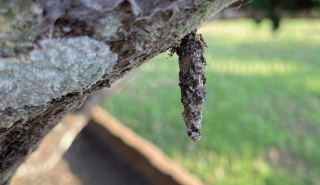
If you see small, spindle-shaped brown bags hanging from arborvitae, bagworms should be near the top of the list.
Homeowners describe them to us in different ways.
They may look like tiny pine cones.
They may look like dead pieces of the tree hanging from a branch.
Some people think they are seed pods.
A mature bag can reach roughly an inch or more in length and may contain pieces of foliage woven into the outside.
Early in the season, the bags are much smaller.
That is one reason infestations are easy to miss.
The caterpillars hatch in late spring and begin creating tiny bags almost immediately. University of Delaware reports that hatch commonly begins around the end of May, although weather and local growing conditions affect the exact timing.
By late summer, the bags are much easier to see.
Unfortunately, the tree may also have lost a lot more foliage by then.
What Does Bagworm Damage Look Like?
Bagworm damage usually begins as thinning foliage.
You might see individual areas of an arborvitae looking lighter than the rest of the plant.
Then you may notice brown patches.
With heavier feeding, entire sections can become bare.
Bagworm caterpillars eat the foliage while carrying their bags with them. As they grow, they eat more and their bags get larger.
This matters much more on evergreens than it does on many deciduous trees.
A deciduous tree such as a maple may be able to grow new leaves after defoliation.
An arborvitae cannot simply replace heavily damaged foliage in the same way.
University of Delaware warns that evergreen trees and shrubs may not recover from complete defoliation.
That is why I would not ignore a heavy bagworm infestation on arborvitae.
Can Bagworms Kill Arborvitae?
Yes.
A severe infestation can kill an arborvitae or another needled evergreen.
That does not mean every tree with a few bags is going to die.
Severity matters.
If I inspect an arborvitae with bagworms, I want to know:
How much green foliage remains?
How widespread is the infestation?
Are multiple plants affected?
Is the plant already under stress?
How much of the tree has been completely defoliated?
And how early did we catch the problem?
University of Maryland Extension notes that heavy bagworm feeding can cause permanent damage to needled evergreens and that heavily infested conifers may die.
That last part is important.
On an evergreen, waiting to see what happens is not always the safest approach.
Can Arborvitae Recover From Bagworm Damage?
Sometimes.
It depends on how much living foliage remains.
If bagworms have only caused light feeding and most of the arborvitae is still green, the plant has a much better chance.
If entire sections are brown and bare, recovery becomes less predictable. At that point the question is often whether the shrub can be saved at all, which is a judgment our team makes the same way we approach reviving any dying shrub.
One thing I tell homeowners is that removing the insect does not automatically restore the missing foliage.
You can stop future feeding.
You cannot undo damage that has already occurred.
That is another reason early detection matters.
It is much easier to protect the foliage that is still there than to rebuild an evergreen after severe defoliation.
The Bagworm Life Cycle Explains Why Timing Matters
Understanding the bagworm life cycle makes treatment much easier to understand.
Bagworm eggs spend the winter protected inside the female's old bag.
A single female can leave hundreds of eggs inside that bag. University of Maryland reports that females can produce about 200 to 1,000 eggs.
The eggs hatch the following spring.
Tiny caterpillars emerge and begin feeding.
Some crawl onto nearby foliage. Others can produce silk strands that allow them to be carried by the wind to another part of the plant or nearby plants.
They immediately begin making small bags.
As summer continues, both the caterpillar and its bag grow.
Later in the season, the caterpillar stops feeding and pupates inside the bag.
Adult males eventually emerge as moths.
The female is very different. She is wingless and remains inside her bag. After mating, she lays her eggs there.
Then the cycle starts again the following spring.
This is why old bags matter.
An apparently empty bag hanging from a branch in winter may contain the next generation.
When Is the Best Time to Treat Bagworms?
This may be the most important part of the entire article.
Young bagworms are easier to control than mature bagworms.
In our area, that generally means paying close attention in late spring and early summer.
Penn State reported active bagworm hatch in Pennsylvania in June 2026 and noted that young larvae were significantly easier to control before substantial bag construction and feeding had occurred.
That matches what we want homeowners to understand.
Do not wait until August just because the bags are easier to see in August.
By that point, the caterpillars have been feeding for weeks.
Timing bagworm treatment around the younger larval stage can give us a much better opportunity to protect the tree.
How to Get Rid of Bagworms
The right method depends on the season, the size of the tree, and how severe the infestation has become.
For a small tree or shrub, one of the simplest methods is physical removal.
Pick the bags off.
Do not just knock them onto the ground.
Bagworm bags removed before spring hatch should be destroyed or placed in the trash so the eggs inside cannot produce another generation. University of Maryland recommends removing bags before hatch in May or early June when hand removal is practical.
For a 5-foot shrub with a handful of bags, that can work very well.
For a 20-foot row of heavily infested arborvitae, handpicking may not be realistic.
That is when bagworm control becomes more of a plant health care issue.
What Is the Best Bagworm Treatment?
There are biological and insecticide options for controlling actively feeding bagworms.
One commonly used biological option is Bacillus thuringiensis var. kurstaki, usually called Bt or Btk.
Bt works best against young caterpillars.
Spinosad is another active ingredient used for bagworm management.
Penn State notes that both Bt and spinosad can be effective while having less impact on many beneficial insects than broad-spectrum options.
But again, timing matters.
As the caterpillar grows and the protective bag becomes larger, treatment can become less effective.
Coverage matters too.
The material needs to reach foliage the caterpillars are actively eating.
That can be difficult on tall arborvitae or dense rows of evergreens.
This is why I would not choose a product first and diagnose the problem second.
We identify the pest.
We determine its stage.
Then we choose the treatment.
Should You Remove Bagworm Bags in Winter?
Yes.
If the bags are within reach, fall and winter are excellent times to remove them.
This is one of the simplest forms of bagworm prevention.
Do not assume the bag is harmless because nothing is crawling out of it.
The female may have left hundreds of eggs inside.
Removing those bags before spring hatch can prevent those eggs from becoming next year's caterpillars.
This is especially useful on arborvitae hedges where a small infestation was caught before it spread through the entire row.
I would also inspect nearby evergreens.
If one arborvitae has bagworms, I do not assume the tree next to it is clear.
Why Arborvitae Need Extra Attention
We see a lot of arborvitae used for privacy screens.
They are planted close together.
That creates exactly the type of situation where one overlooked pest problem can affect an entire row.
Once several arborvitae begin browning, homeowners sometimes assume the problem is drought, winter damage, or disease.
Sometimes it is.
But if I see brown sections during the growing season, I also look closely for insects.
Bagworms can blend almost perfectly into arborvitae foliage.
That is why getting close to the tree matters.
A row may look generally brown from the driveway. If you are already seeing that browning, our guide on why arborvitae turn brown walks through the full list of causes.
Up close, you may suddenly notice dozens of bags.
When Should You Call an Arborist for Bagworms?
If you see a few reachable bags on a healthy shrub, removing them yourself may be all that is necessary.
I become more concerned when:
The tree is too tall to inspect properly.
There are dozens or hundreds of bags.
Several arborvitae are affected.
Large sections are already brown.
You are seeing new feeding during spring or summer.
Or you are not sure whether bagworms are actually causing the decline.
At Strobert Tree Services, we do not just look at the bags.
We look at the condition of the whole plant.
Bagworms may be the problem, but arborvitae can also decline from mites, scale insects, root problems, moisture stress, winter injury, disease, and other issues. Telling these apart is exactly what a proper tree disease and pest inspection is for.
The goal is to make sure we are treating the right problem at the right time.
If you see bagworms on your arborvitae or other trees, call Strobert Tree Services for professional tree and shrub plant health care in Delaware and Pennsylvania. Call us at 1-800-TREE-SERVICE or request a free consultation online.
The earlier we identify the problem, the more foliage we may be able to protect.