If your rhododendron, azalea, or yew has neat U-shaped notches along the edges of its leaves, there is a good chance a black vine weevil has been feeding on it.
Those notches are usually what homeowners notice first.
But they are not what concerns me most.
When we inspect a plant for black vine weevil damage, I am much more interested in what may be happening below the soil. Adult weevils chew the leaves. Their larvae feed on the roots.
The leaf damage is usually cosmetic. The root damage can kill the plant.
That difference is important because homeowners often try to treat what they can see while missing the stage of the insect doing the most serious damage.
What Is a Black Vine Weevil?
The black vine weevil, or Otiorhynchus sulcatus, is a small beetle that feeds on many common landscape plants.
Rhododendrons and yews are favorites. We also find problems on azaleas, euonymus, Japanese holly, hemlock, and many other ornamental plants.
You may hear people call it a rhododendron weevil, yew weevil, or Taxus weevil because of the plants it frequently attacks. Black vine weevil is the more precise name.
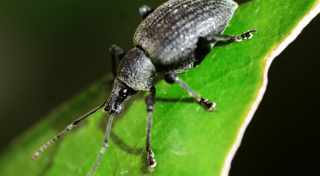
Adult black vine weevils are dark gray to black and have a short snout. They are generally about 3/8 to 1/2 inch long.
They are also flightless.
That is a useful detail when we are figuring out how an infestation may have spread. These beetles have to walk from plant to plant, although they can also arrive on infested nursery stock.
Are Notches in Rhododendron Leaves a Sign of Vine Weevil?
They can be.
The classic sign of adult vine weevil feeding is a series of rounded or U-shaped notches on leaves.
The beetle starts at the outer edge and chews inward. On a rhododendron, it can leave the leaf margin looking like someone took a tiny hole punch to it.
If someone asks me, "What is eating my rhododendron leaves?", this is one of the patterns I look for.
The same applies when someone asks, "What is eating my azalea leaves?"
Black vine weevils feed mostly at night. During the day, they often hide beneath mulch, leaf litter, or dense foliage. That means you can have obvious notches in rhododendron leaves without ever seeing the insect responsible.
One simple way to investigate is to go outside after dark with a flashlight. You can also place something light-colored beneath the shrub and shake the branches. Adult weevils often drop when disturbed.
The Leaf Damage Is Usually Not the Biggest Problem
This is the part I want homeowners to understand.
Those chewed leaves can look terrible.
But adult feeding usually does not cause serious harm to an established plant. Even extensive leaf notching seldom affects plant health on its own.
The vine weevil larvae are a different story.
They live underground.
Young larvae begin by feeding on smaller roots. As they grow, they can attack larger roots and the root crown. Severe feeding can strip bark from roots or girdle the plant.
That interrupts the plant's ability to move water and nutrients.
So when I see fresh notches on a rhododendron, I do not just look at the leaves.
I look at the entire plant.
Is it wilting?
Has growth slowed?
Are sections of the plant declining?
Is it failing to recover even though the soil has adequate moisture?
Those symptoms can tell us the problem has moved beyond cosmetic leaf feeding.
Why Is My Rhododendron Wilting or Dying?
If a rhododendron has notched leaves and is also wilting or declining, vine weevil grubs should be considered.
The larvae are white or cream-colored, legless, curved into a C shape, and have brown heads.
They stay in the soil around the roots, which is why homeowners rarely see them.
A plant with damaged roots may begin to lose vigor. Leaves can yellow. New growth can slow. A severely damaged shrub may wilt even when the surrounding soil seems moist. If you are seeing yellowing you cannot explain, our guide on why leaves turn yellow covers the full range of causes worth ruling out.
In heavy infestations, root feeding can eventually kill the plant. Because root damage also opens the door to problems like root rot, a struggling shrub often has more than one thing going wrong below the soil.
This is what I mean when I say the damage you see is not always the damage that matters.
The leaf notches are the warning sign.
The roots are where I want to know what is happening next.
Vine Weevil Life Cycle
Understanding the vine weevil life cycle helps explain why control has to target the right stage.
In Pennsylvania, black vine weevil generally has one generation per year.
The insect usually spends winter as a larva in the soil. The larvae become active again as conditions warm and later pupate.
Adults typically begin emerging in late spring and early summer.
They feed on foliage before laying eggs in the soil near host plants. Those eggs hatch into new larvae, which begin feeding on roots.
There is another unusual detail about this insect.
In North America, black vine weevil populations are essentially female. They reproduce without mating, a process called parthenogenesis. Females can lay hundreds of eggs.
That helps explain how a small infestation can become a much larger problem.
You do not need pairs of beetles reproducing. One female can start the next generation.
Do Vine Weevils Fly?
No.
Adult black vine weevils are flightless.
They move by crawling.
That means an infestation usually spreads more slowly through a landscape than an insect capable of flying from yard to yard.
But there is an important exception.
Weevils and larvae can be moved with plants.
That is why I recommend paying attention to new rhododendrons, yews, azaleas, and other susceptible plants before adding them to an established landscape.
An infested container plant can introduce the pest to an area that did not have it before.
Black Vine Weevil vs. Japanese Beetle
These two pests sometimes get confused because both chew ornamental plants.
Their feeding patterns are quite different.
A black vine weevil normally starts at the edge of a leaf and creates rounded notches.
Japanese beetles tend to eat the tissue between leaf veins. That produces a thin, lace-like or skeletonized leaf. Our post on Japanese beetle damage covers that pattern in detail.
Japanese beetles are also strong flyers and are often easy to see feeding in groups during the day. Black vine weevils cannot fly and usually feed at night.
Those differences can help narrow down what is attacking your plant before treatment begins.
How to Get Rid of Vine Weevil
Good black vine weevil control starts with knowing whether you are dealing with adults, larvae, or both.
There is not one treatment that makes sense in every situation.
For a small number of plants, adults can sometimes be removed at night by hand and dropped into soapy water.
But remember what I said earlier.
Killing a few adults does not necessarily address larvae that are already feeding underground.
That is why we base black vine weevil treatment on the insect's life stage and the condition of the plant.
Do Vine Weevil Nematodes Work?
Vine weevil nematodes can be useful for controlling larvae in the soil.
These are beneficial microscopic organisms that seek out susceptible insect larvae.
Research and Extension recommendations include species in the Heterorhabditis group for black vine weevil control.
But application conditions matter.
Beneficial nematodes need adequate soil moisture. Soil temperature also affects their performance. Applying them to dry soil and hoping for the best is not a treatment plan.
This is a good example of why pest control is often more about timing than simply choosing a product.
What About Insecticides?
There are insecticides labeled for black vine weevil treatment, including options that target adults and systemic treatments that may be used in certain situations.
Imidacloprid is one systemic active ingredient listed by Extension sources for black vine weevil management. However, systemic insecticides can also pose risks to pollinators and other beneficial insects, particularly when used around flowering plants. State restrictions can apply as well.
That is why I would not recommend treating every notched rhododendron automatically.
First identify the pest.
Then determine whether the plant is actually at risk.
Then choose the least disruptive treatment that can realistically solve the problem.
For professional applications, the product must also be labeled for the target pest and site and used according to the label and applicable state regulations.
How to Prevent Black Vine Weevils
You cannot guarantee that a black vine weevil will never show up.
But you can reduce your chances of turning one pest into a landscape-wide problem.
Inspect susceptible plants before planting them. Look at leaf margins for old notching. Check the root ball and container when possible.
Avoid moving obviously infested plants around the property.
Keep mulch at a reasonable depth and pay attention to areas where adult weevils can hide. Piling it too deep against the base of a shrub only gives them more cover, which is one of several reasons proper mulching matters more than people think.
Most importantly, monitor plants once you find the characteristic leaf damage.
Those notches are useful information.
Do not just look at them as an ugly leaf.
Look at them as an early warning.
When Should You Call an Arborist?
A few notched leaves do not automatically mean your rhododendron or yew is dying.
But if you see U-shaped notches on leaves along with wilting, yellowing, weak growth, or unexplained decline, I would investigate further. In some cases a struggling shrub can still be turned around, which our guide on how to revive dying shrubs walks through.
At Strobert Tree Services, we look at the plant as a whole.
We want to know what caused the visible damage, whether larvae are threatening the roots, how much stress the plant is already under, and whether treatment makes sense.
That is the difference between treating a symptom and actually managing the problem.
If you think you are seeing black vine weevil damage, call Strobert Tree Services for professional tree and shrub plant health care. We can identify the problem and recommend the right next step for your landscape. Call us at 1-800-TREE-SERVICE or request a free consultation online.