
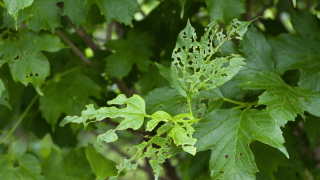
If the leaves on your viburnum look like they have been shredded, skeletonized, or filled with irregular holes, look closely before blaming caterpillars.
You may have viburnum leaf beetle.
Viburnum leaf beetles feed only on plants in the Viburnum genus. Both the larvae and adult beetles eat the leaves, which means the same shrub can be attacked twice during one growing season.
A heavy infestation can strip most of the foliage from a susceptible viburnum.
One bad year may make the plant look terrible. Repeated defoliation is much more serious. A viburnum that loses large portions of its leaves year after year can become weak and eventually die.
The good news is that this pest gives us several opportunities to catch it before the damage becomes severe.
What Is a Viburnum Leaf Beetle?
The viburnum leaf beetle, or Pyrrhalta viburni, is an invasive beetle native to Europe and Asia.
It feeds almost exclusively on viburnum shrubs and small trees.
The insect has spread through much of the northeastern United States, and Pennsylvania considers it an invasive insect of concern.
Homeowners often notice the damage before they notice the beetle.
That is because the larvae are small and feed on the underside of the leaves. Adult beetles are also fairly plain looking.
The damaged leaves are much harder to miss.
What Does Viburnum Leaf Beetle Damage Look Like?
Early damage often starts as small holes in the leaves.
As feeding continues, those holes grow and merge.
Eventually, much of the soft tissue between the veins may disappear. The leaf begins to look skeletonized.
Typical viburnum leaf beetle damage includes:
- Small holes scattered across leaves
- Larger irregular holes as feeding increases
- Skeletonized leaves
- Brown or dried leaf tissue
- Severe defoliation
- Thin-looking shrubs
- Reduced growth after repeated attacks
A badly damaged viburnum may look almost bare by early summer.
Then something frustrating can happen.
The shrub produces another flush of leaves.
Adult beetles emerge later in the season and start eating those too.
That is one reason this pest can put so much stress on susceptible plants.
What Is Eating My Viburnum Leaves?
Several insects can damage viburnum, so holes alone do not confirm viburnum leaf beetle.
Caterpillars, Japanese beetles, aphids, thrips, and other pests can also affect shrubs.
The feeding pattern gives us clues.
Viburnum leaf beetle larvae often begin by chewing small holes through the leaf tissue while leaving the larger veins behind. Heavy feeding creates the skeletonized appearance.
Japanese beetles also skeletonize leaves, but adult Japanese beetles are much easier to recognize. They have metallic green bodies with copper-colored wing covers and often feed in visible groups.
Viburnum leaf beetles are smaller and much less noticeable.
Knowing exactly which pest is feeding matters because treatment timing is different for each one.
What Do Viburnum Leaf Beetle Larvae Look Like?
The larvae usually appear in spring.
Young larvae are yellowish-green. As they grow, they develop darker markings and spots along their bodies.
They can eventually reach about one-third of an inch long.
Look on the underside of damaged leaves.
The larvae often feed together, especially when they are young.
That group feeding can cause a surprising amount of damage in a short period.
If you notice fresh holes in viburnum leaves during spring, turn several leaves over and inspect the undersides.
Catching the larvae at this stage is much better than discovering the problem after most of the shrub has already been eaten.
What Do Adult Viburnum Leaf Beetles Look Like?
Adult viburnum leaf beetles appear later in the season.
They are small, brownish beetles about one-quarter inch long.
They are not especially distinctive.
If you saw one sitting on a leaf without knowing what you were looking for, you might not give it much attention.
But the feeding gives them away.
Adults chew irregular holes in viburnum leaves and can continue damaging shrubs through summer.
The adults eventually mate, and females lay eggs in the twigs.
Those eggs survive the winter and start the cycle again the following spring.
Where Do Viburnum Leaf Beetles Lay Their Eggs?
This is one of the most useful things to know about this pest.
Female viburnum leaf beetles do not simply scatter their eggs across the leaves.
They chew small cavities into young twigs and deposit their eggs inside.
The openings are then covered with a protective material.
When you know what to look for, these egg-laying sites can sometimes be seen during winter as small raised scars arranged in rows along the twig.
That gives us an opportunity to reduce next year's beetle population before the eggs ever hatch.
Penn State Extension recommends inspecting viburnums during the dormant season and pruning out twigs containing egg-laying sites when practical.
For a homeowner with only a few shrubs, winter inspection can make a real difference.
Viburnum Leaf Beetle Life Cycle
Understanding the life cycle makes viburnum leaf beetle treatment much easier.
The insect generally produces one generation per year.
Winter
The pest survives winter as eggs inside viburnum twigs.
Spring
Eggs hatch as temperatures warm.
The larvae begin feeding on newly developing leaves.
This is often when the first major wave of damage occurs.
Early summer
Mature larvae leave the plant and move into the soil to pupate.
For a short period, beetle activity on the shrub may seem to disappear.
That does not mean the infestation is over.
Mid to late summer
Adult beetles emerge from the soil and return to viburnum plants.
They begin feeding on the foliage again.
Late summer and fall
Females chew holes in young twigs and lay the eggs that will survive until the following spring.
Then the cycle repeats.
This is why random spraying is not a good pest-control plan.
There are specific points in this life cycle when management is much more effective.
Which Viburnums Are Most Susceptible?
Viburnum leaf beetles do not attack every viburnum equally.
Some species are highly susceptible.
Others are much less attractive to the beetle.
Arrowwood viburnum (Viburnum dentatum) is among the plants that can suffer serious damage.
European cranberrybush viburnum and several other species are also highly susceptible.
Cornell research has found that some thicker-leaved viburnums tend to be more resistant.
That matters if you repeatedly lose viburnums to this pest.
Sometimes the long-term solution is not continuing to treat a highly susceptible shrub indefinitely.
Replacing it with a less susceptible viburnum may make more sense.
Plant selection is part of pest management too.
Can Viburnum Leaf Beetles Kill a Shrub?
Yes.
A healthy shrub can usually survive some leaf loss.
The bigger concern is repeated heavy defoliation.
Leaves are how the plant produces energy.
When larvae remove much of the spring foliage, the viburnum has to use stored energy to replace those leaves.
Then adult beetles can attack the replacement foliage later in the season.
If that happens repeatedly, the plant loses vigor.
Growth slows.
Branches may begin dying back.
The shrub becomes less capable of handling drought, root problems, disease, and other environmental stress.
Research from Cornell has shown that repeated defoliation can eventually kill susceptible viburnums.
One season of holes is a warning.
Several seasons of severe defoliation are a much bigger problem.
How Do You Get Rid of Viburnum Leaf Beetles?
There is no single viburnum leaf beetle treatment that makes sense at every point in the year.
I would rather target the pest when it is most vulnerable.
Prune out egg-infested twigs
Winter is one of the best times to inspect a known problem plant.
Look closely at young twigs for rows of egg-laying scars.
If practical, those sections can be pruned out and disposed of before the eggs hatch.
Penn State specifically recommends this as a dormant-season management technique.
Target young larvae
Spring provides another important treatment window.
Young larvae are generally easier to control than adult beetles.
This is also when stopping the pest can prevent the first round of serious defoliation.
Timing matters.
Waiting until most of the foliage has already disappeared reduces what a treatment can accomplish that season.
Monitor for adults
Adult beetles can cause another wave of feeding during summer.
Inspect previously infested shrubs even if the spring damage appears to have stopped.
Fresh holes later in the season may indicate that adults have emerged.
Should I Spray My Viburnum?
Not automatically.
First confirm the pest.
A few holes on an otherwise healthy shrub may not justify treatment.
A heavily infested, highly susceptible viburnum may be a different situation.
Treatment options can include horticultural products or insecticides labeled for viburnum leaf beetle, depending on the insect's life stage and the condition of the plant.
There is also another consideration.
Viburnums flower.
Those flowers can attract bees and other pollinators.
Cornell's Integrated Pest Management guidance recommends considering bloom and pollinator activity when choosing and timing insecticide treatments.
That is one reason I would not recommend simply buying a pesticide and spraying whenever you notice damaged leaves.
Identify the pest.
Determine its life stage.
Then choose the treatment and timing that makes sense.
That is the basic approach we use with integrated, least-toxic pest management.
Can You Prevent Viburnum Leaf Beetle?
You probably cannot guarantee that a beetle will never reach your landscape.
You can make an infestation easier to manage.
Start by inspecting viburnums regularly.
Spring is especially important.
Check the undersides of newly developing leaves for larvae and fresh feeding.
During winter, inspect twigs for egg-laying scars.
If you are planting new viburnums, consider species that are less susceptible to the beetle.
And keep the plants healthy.
Adequate water, proper mulch, suitable soil, and good growing conditions will not stop viburnum leaf beetles from feeding.
But a healthy shrub is better able to recover from moderate damage than one already struggling with drought or root stress.
Viburnum Leaf Beetle vs. Other Viburnum Problems
Do not assume every unhealthy viburnum has beetles.
Leaf discoloration without holes may point to something else.
Fine stippling can indicate mites or other sap-feeding insects. Our guide to the early signs of spider mites explains what that damage looks like.
Yellow leaves can come from watering problems, nutrient issues, root damage, or disease. We cover those possibilities in our guide to why tree leaves turn yellow.
Viburnums can also develop fungal diseases, aphid problems, borers, and other health issues.
The pattern of damage helps narrow things down.
Large amounts of missing leaf tissue point us toward a chewing insect.
Skeletonized leaves combined with larvae on the underside make viburnum leaf beetle much more likely.
Why Does My Viburnum Keep Getting Beetles Every Year?
If the same shrub is attacked every year, look at the beetle's life cycle.
Eggs may already be overwintering inside the twigs.
When spring arrives, those eggs hatch directly onto the plant.
That means the next infestation can begin before beetles from somewhere else ever reach your yard.
This is why winter egg inspection is so valuable.
It also explains why treating only the adult beetles during summer may not solve the entire problem.
By that point, the shrub has already survived one round of larval feeding.
The better strategy is to interrupt the cycle earlier.
Should I Replace a Viburnum That Keeps Getting Defoliated?
Sometimes.
A mature, valuable shrub with manageable pest pressure may be worth protecting.
A severely weakened shrub that gets stripped every year may not be.
The species matters too.
If you have a highly susceptible viburnum in an area with repeated beetle pressure, replacing it with a more resistant species can reduce the amount of treatment needed in the future.
That is not giving up on the plant.
It is choosing a landscape that is easier to maintain.
When Should You Call an Arborist?
A few holes in your viburnum leaves are not an emergency.
But I would take a closer look if:
The shrub is losing a large percentage of its foliage.
You see larvae covering the undersides of leaves.
The problem happens every spring.
Adults begin feeding again later in summer.
Several viburnums are affected.
Or the plant is already showing dieback and poor growth.
At Strobert Tree Services, we look at more than the damaged leaf.
We identify the insect, determine what stage of its life cycle is present, evaluate how much damage the plant has suffered, and decide whether treatment makes sense.
Viburnum leaf beetle is much easier to manage when we catch the problem before repeated defoliation weakens the shrub.
If the leaves on your viburnum are full of holes or look skeletonized, contact Strobert Tree Services for professional plant health care in Delaware and southeastern Pennsylvania. Call us at 1-800-TREE-SERVICE or request a free consultation online.
We can identify what is feeding on the plant and recommend the right next step.