When people ask us about the 3 30 300 rule for trees, we like to explain it in simple terms. It is a practical idea that helps people think about how trees improve daily life. It is not just about making a street look nicer. It is about shade, comfort, health, walkability, and the long term strength of a neighborhood. At Strobert Tree Services, we spend a lot of time helping property owners care for trees one by one. But we also see the bigger pattern. Neighborhoods with healthy trees usually feel cooler, more settled, and more inviting.
The 3 30 300 rule gives communities a simple way to think about that bigger picture. It says people should be able to see at least three trees from where they live, work, or learn. Their neighborhood should have at least 30 percent tree canopy cover. And they should live within 300 meters of a high quality green space. That framework has been explained by the NBSI overview of the 3 30 300 principle, the Penn State Extension guide to the 3 30 300 rule for community greening, and the official 3 30 300 rule resource.
We like this rule because it is easy to remember. More important, it keeps the focus on people. Trees should improve how a place feels and functions. They should not just fill space on a plan.
What is the 3 30 300 rule for trees?
The 3 30 300 rule for trees is an urban planning concept built around three clear goals. First, every person should be able to see at least three trees from their home, school, or workplace. Second, every neighborhood should aim for 30 percent tree canopy cover. Third, every resident should be within 300 meters of a high quality green space, such as a park, trail, or green corridor.
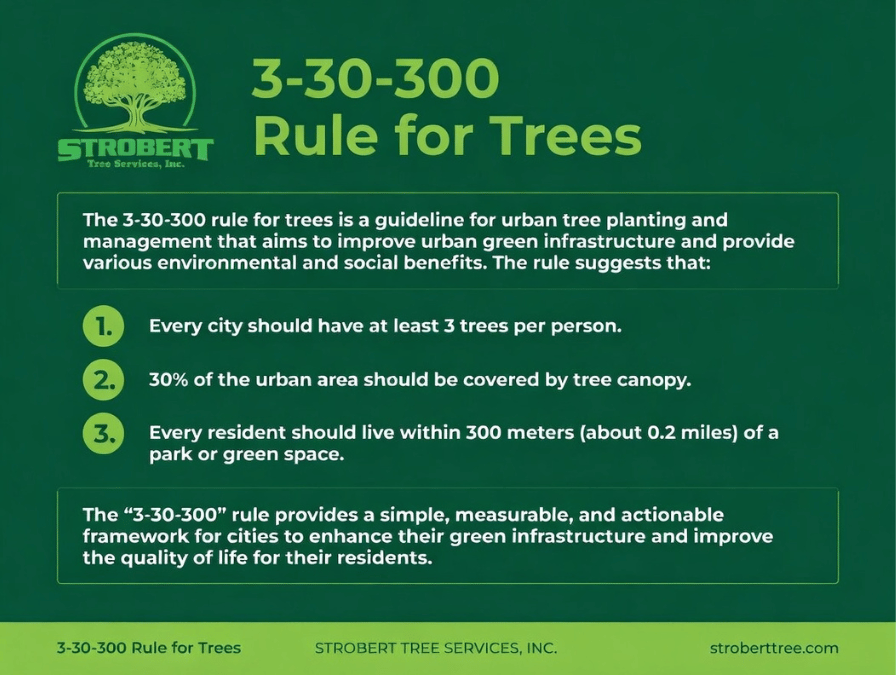
We see this as a useful benchmark because it turns a broad idea into something real. A lot of people say they want greener communities. That sounds great, but it can also feel vague. This rule gives homeowners, local leaders, and planners something more specific to measure. Can people actually see trees? Is there enough canopy to create shade and reduce heat? Is green space close enough to be part of daily life?
That is also why this rule matters at the property level. A healthy tree in the right place can do more than improve curb appeal. It can add shade to a patio, make a front yard feel more established, and contribute to the neighborhood canopy over time. If a tree is struggling, timely plant health care can make the difference between preserving it and losing it.
Public Health & The 3 30 300 Rule
We think one of the best parts of the 3 30 300 rule is that it connects trees to public health in a way people can actually understand. Trees help cool built up areas. They provide shade over sidewalks, homes, and parked cars. They can make outdoor time more comfortable during hot months. They also help soften the look and feel of hard surfaces like roads, driveways, and buildings.
In our experience, neighborhoods with stronger tree cover tend to feel calmer and more balanced. People are more likely to spend time outside when a street has shade and visual interest. Kids are more likely to use parks that feel inviting. Homeowners also tend to value mature trees more once they live through a stretch of summer heat without them.
This is where the rule becomes more than a planning slogan. It becomes a quality of life issue. If a neighborhood has weak canopy, little shade, and no nearby green space, people feel it even if they do not use technical terms to describe it. They just know the street feels hotter, harsher, and less welcoming.
We also think the rule is helpful because it reminds people that mature trees matter. A newly planted tree is a great step, but it does not provide the same canopy, shade, or environmental value as a healthy established tree. That is one reason we often encourage clients to protect mature trees whenever possible through proper pruning services, ongoing monitoring, and site planning that avoids unnecessary root damage.
Why Seeing 3 Trees Matters
The first part of the rule may sound simple, but it is powerful. Seeing three trees from a window or front step can change how a space feels. We have worked on properties where a single well placed tree transformed the entire front yard. It gave the home structure. It softened the view. It made the space feel less exposed.
That is why tree placement matters just as much as tree count. We always look at the site first. How much room does the tree have? What will it look like at maturity? Will it conflict with structures or overhead lines? Is the tree being planted where people will actually benefit from its shade and presence?
Sometimes the best next step is strategic tree trimming services to improve structure, light flow, and long term health. Other times, a declining or poorly placed tree may need tree removal services before a better long term planting plan can move forward. Good canopy starts with good decisions.
Why 30 Percent Canopy Cover Matters
The second part of the 3 30 300 rule for trees focuses on neighborhood canopy. This is where the conversation shifts from one yard to the whole community. Tree canopy is the layer of leaves and branches that covers the ground when viewed from above. The more healthy canopy an area has, the more benefits it tends to receive.
We see those benefits all the time. More canopy usually means more shade. It can also help reduce heat buildup around homes and pavement. In some cases, it can improve how stormwater moves through a landscape. Trees are not a cure all, but they are a major part of how a neighborhood handles weather and wear over time.
That said, canopy is not just about planting new trees. It is also about keeping existing trees healthy. If mature trees are neglected, topped, damaged during construction, or removed without a plan, a neighborhood can lose decades of growth fast. That is one reason we talk so much about maintenance on our tree service blog. Healthy canopy takes time to build, and it takes consistent care to protect.
Storms are another part of this conversation. A neighborhood can lose significant canopy in one rough season if weak trees and broken limbs are not addressed early. When damage happens, responsive storm damage tree services help protect property and preserve what can still be saved.
Why 300 Meters to Green Space Matters
The third part of the rule focuses on access. A park on the other side of town is not the same as a green space you can actually walk to. We think this is one of the most people first parts of the whole idea. If a trail, park, or green corridor is close by, it becomes part of normal life. People use it more. Families visit more often. It becomes a real neighborhood asset instead of a place you only reach when you have extra time.
This part of the rule also speaks to fairness. Everyone should benefit from trees and green space, not just a few neighborhoods. We serve many communities throughout the region, including homeowners looking for trusted tree care in Chester County, PA, as well as local services in Wayne, Pennsylvania and West Chester, Pennsylvania. One thing we have learned is that every community benefits when tree care is treated as long term infrastructure, not an afterthought.
What Homeowners Can Do With This Idea
You do not need to be an urban planner to use the 3 30 300 rule as a helpful guide. We think homeowners can use it to ask better questions about their own property and neighborhood. Can you see healthy trees from your windows? Does your street have enough shade to make summer more bearable? Is there a walkable green space nearby? Are the trees on your property likely to thrive for years, or are they already showing signs of decline?
If you are not sure, that is where an arborist can help. We can assess tree health, structure, root concerns, storm risk, and long term suitability. In some cases, a simple care plan is enough. In other cases, a property may need pruning, treatment, replacement planting, or a clearer understanding of likely costs. For homeowners who want to plan ahead, our tree service pricing page can help set expectations before scheduling work.
We also encourage property owners to think long term. Trees are not quick fixes. The right tree in the right place can improve a property for decades. The wrong tree in the wrong place can create recurring problems. That is why people first tree care starts with honest advice.
Our Take as Arborists
We believe the 3 30 300 rule for trees is useful because it keeps the focus where it belongs. On people. On neighborhoods. On long term value. It helps explain why tree care matters beyond appearance. Trees shape how a place feels. They also shape how a place functions.
From our side, that means proper pruning when a tree can be improved, plant health care when a tree can be supported, safe removal when a tree becomes a liability, and practical guidance for what should come next. Good tree care is not about doing the most work. It is about doing the right work for the tree, the property, and the people who live there.
If you want help evaluating the trees on your property, planning next steps, or understanding what care makes sense for your landscape, you can request free estimates or contact Strobert Tree Services to speak with our team. We are always happy to help homeowners make informed decisions that support healthier trees and better outdoor spaces.