
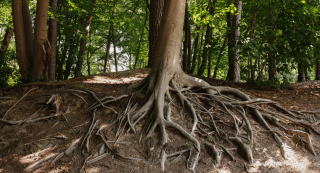
If your tree is thinning, turning color early, or struggling even though you water it, I would take a close look at the base of the trunk.
Does the trunk flare outward as it reaches the ground?
Or does it go straight into the soil like a telephone pole?
That difference can tell us a lot.
One possible problem is girdling roots.
A girdling root grows around or against the trunk instead of growing away from the tree. As both the root and trunk get larger, they begin pressing against each other.
Over time, that pressure can interfere with the movement of water and nutrients through the tree.
The difficult part is that this can happen slowly.
At Strobert Tree Services, we may see a tree that has been declining for years before anyone realizes the real problem is below the soil.
What Are Girdling Roots?
A girdling root is a root that grows across or around the base of a tree and begins pressing against the trunk.
Think about a belt getting tighter while the tree keeps growing.
A young root may not look dangerous.
But trees and roots continue increasing in diameter every year.
Eventually, the root can compress the trunk and interfere with the vascular tissue that moves water and nutrients through the tree.
Penn State Extension explains that girdling roots can slowly restrict sap flow, weaken portions of the root system, cause canopy decline, and eventually affect the structural strength of the tree.
That is why I do not like ignoring a girdling root just because the tree looks healthy today.
The question is what that root will do over the next 10 or 20 years.
What Do Girdling Roots Look Like?
Sometimes the problem is obvious.
You may actually see a large root wrapping around the trunk.
Other times, the root is hidden under soil or mulch.
That is when the shape of the trunk becomes useful.
A healthy tree should normally have a visible root flare.
The trunk should widen where it enters the ground.
If the trunk stays almost the same width and disappears straight into the soil, I start wondering whether the tree was planted too deeply or whether roots are circling below the surface.
University of Minnesota Extension describes that telephone-pole appearance as one of the warning signs of underground stem-girdling roots.
We may also see one side of the trunk looking flattened or compressed where a root is pushing against it.
Those details at ground level are easy to miss if the area is covered by mulch.
What Are the Symptoms of Girdling Roots?
This is where diagnosing the problem gets tricky.
Girdling root symptoms can look like many other tree problems.
A tree may have a thin canopy.
Leaves may be smaller than normal.
The tree may grow slowly.
Leaves may yellow, wilt, develop brown edges, or fall earlier than expected.
Branches may begin dying back.
In some cases, one part of the canopy looks much worse than another.
Those symptoms can easily make someone think the tree needs more water or fertilizer.
But if a root is restricting the tree's vascular system, simply adding fertilizer does not fix the cause.
University of Minnesota lists poor growth, early fall color, leaf scorch, wilting, premature leaf drop, and dieback among symptoms associated with girdling roots.
That is why I always want to look at the whole tree.
The leaves tell us something is wrong.
The base of the trunk may tell us why.
Why Do Trees Develop Girdling Roots?
One of the biggest causes starts before the tree ever reaches your yard.
Container-grown trees can develop roots that circle around the inside of the pot.
If those roots are not corrected before planting, they may continue growing in that same direction after the tree goes into the ground.
Planting too deeply can also contribute to root problems.
Roots need oxygen.
When the root flare is buried beneath several inches of soil or excessive mulch, roots may grow upward or sideways into areas where oxygen is more available.
That can create abnormal root patterns close to the trunk.
This is one reason we pay so much attention to planting depth.
A tree can survive being planted incorrectly for years.
That does not mean it was planted correctly.
Some of the worst planting problems are delayed problems.
The Root Flare Tells Us a Story
One of the first places I look when evaluating an unexplained tree decline is the root flare.
You should normally be able to see the base of the trunk widen before the main roots enter the soil.
If I cannot find that flare, I want to know why.
Sometimes there is simply too much mulch.
Sometimes soil has been added around the tree.
Sometimes the tree was planted too deeply from day one.
And sometimes we uncover the soil and find roots wrapping around the trunk.
This is an important point for homeowners because the trunk should not look like a fence post stuck into the ground.
That appearance may be telling you there is a problem underneath.
Can Girdling Roots Kill a Tree?
Yes.
But it normally does not happen quickly.
A tree can live with a girdling root for many years while gradually losing vigor.
That slow decline is what makes the problem easy to overlook.
As the trunk and root grow against each other, more pressure develops.
Parts of the canopy may begin dying because the corresponding roots are no longer functioning properly.
In advanced cases, girdling roots can also contribute to structural weakness.
University of Minnesota notes that affected trees can break near the soil line during wind events.
That changes the issue from tree health to tree safety.
A large declining tree close to a house, driveway, road, or play area deserves a closer evaluation.
Should You Cut a Girdling Root?
This is where I would be careful with DIY advice.
Sometimes, yes.
A small girdling root found early can often be removed before it becomes a major problem.
Penn State recommends addressing smaller girdling roots early and consulting a Certified Arborist when the root has become large.
But cutting a large root from a mature tree is not automatically the right answer.
That root may now be providing a significant amount of water and structural support.
Removing it can sometimes cause more damage than leaving it.
The Morton Arboretum notes that large girdling roots can be difficult to correct because removing them may damage enough of the root system to accelerate decline.
This is why I would not tell someone to find a saw and start cutting roots.
We need to know how large the root is, where it connects, how much of the trunk it affects, and what condition the rest of the tree is in.
How Do Arborists Treat Girdling Roots?
The first step is exposing enough of the root flare to understand what is happening.
That may involve carefully removing excess soil or mulch around the base.
For more complicated cases, an arborist may use an air excavation tool to uncover roots without the same risk of damaging them with a shovel.
Once we can actually see the root structure, we can make a better decision.
A small problematic root may be removed.
A larger root may require a more conservative approach.
Sometimes we determine that removing it would create too much risk.
There is no universal girdling root treatment.
The right decision depends on the specific tree.
That is one reason experience matters.
Can a Tree Recover After Girdling Root Removal?
It can.
But removing the root does not make years of stress disappear overnight.
If we catch the problem while the tree still has a healthy canopy and functional root system, the outlook is much better.
A severely declining tree may not fully recover even after the pressure is removed.
After correcting the root problem, we still need to think about overall tree health.
That may include proper watering during drought, protecting the root zone, correcting excess mulch, and monitoring the canopy.
The goal is to give the remaining root system the best conditions possible.
How Do You Prevent Girdling Roots?
Prevention starts when the tree is planted.
Before planting a container-grown tree, the root system should be inspected for circling roots.
The tree should also be installed at the correct depth with the root flare visible.
The Morton Arboretum recommends correcting circling roots in nursery stock at planting rather than allowing them to continue growing around the root ball.
After planting, avoid piling mulch around the trunk.
The familiar "mulch volcano" does not help the tree.
Keep mulch away from direct contact with the trunk and make sure the root flare remains visible.
Those simple decisions can prevent a problem that otherwise may not become obvious for decades.
When Should You Call an Arborist?
If a tree has been slowly declining and you cannot find an obvious reason, look at the base.
A missing root flare is worth investigating.
So is a visible root wrapping around the trunk.
I would also have the tree evaluated if you see thinning foliage, repeated leaf scorch, early fall color, one-sided decline, or unexplained branch dieback.
At Strobert Tree Services, we do not assume every declining tree needs fertilizer, more water, or pest treatment.
Sometimes the real problem is underground.
We look at the trunk, root flare, soil conditions, canopy, planting depth, and overall structure before recommending what to do next.
A girdling root caught early can sometimes be corrected.
A girdling root ignored for years can become much more complicated.
If you think your tree may have girdling roots, call Strobert Tree Services for professional tree plant health care in Delaware and Pennsylvania. Call us at 1-800-TREE-SERVICE or request a free consultation online. We can identify what is happening below the surface and determine whether the tree can be helped.